case study |
 |
 o be successful at a trade show, you’ve got to know the tools of the trade — and how to use them. But for Interlake Material Handling Inc., it’s all about helping its prospective clients learn the tools of their trade. That’s why the Naperville, IL,-based pallet-rack manufacturer had lofty goals — and a little apprehension — going into the 2006 Material Handling Industry of America’s North American (NA) show. o be successful at a trade show, you’ve got to know the tools of the trade — and how to use them. But for Interlake Material Handling Inc., it’s all about helping its prospective clients learn the tools of their trade. That’s why the Naperville, IL,-based pallet-rack manufacturer had lofty goals — and a little apprehension — going into the 2006 Material Handling Industry of America’s North American (NA) show.
Typically, Interlake wouldn’t make much of a showing at the biennial NA Show. As the off-year alternate to the MHIA’s larger biennial ProMat show — an event Interlake counts among its most important events — NA hadn’t merited more than a humble pop-up and a low-key presence from Interlake in the past. But 2006 was far from a typical year for Interlake. With its new Interlock bolted rack system set to throw a wrench into the U.S. rack market (which until recently consisted exclusively of welded options), the manufacturer knew it had to re-tool its standard NA strategy in order to make an impression.
“In the U.S., pallet-rack frames are made by welding components together. It’s been like that for 50 years. The rest of the world is bolted,” says Interlake marketing manager Vincent DePaola, explaining the monumental shift the Interlock launch represented. With Interlake claiming a 15- to 16-percent market share and holding steady as the industry leader in U.S. rack sales, the company’s conversion from welded to bolted was “a very big deal,” according to DePaola.
As Interlake readied itself for February’s Interlock rollout, the company recognized that NA, scheduled for the Cleveland International Expo Center in March, offered a perfect opportunity to capitalize on the Interlock launch, and make strides in market interest leading up to ProMat in January 2007.
To build momentum for the new product, the company would have to build a booth that didn’t just attract attendees, but hooked them into sticking around long enough to find out about the advantages afforded by the new system. These included improvements in rack configuration, versatility, and freight value. “With welded racks, you’re paying to ship a lot of air,” DePaola explains. “With bolted racks, you can knock them down and condense a lot of things that nest together, then assemble them on site. There’s freight savings and flexibility, and it’s better for the customer.”
Interlake also needed to alleviate fear of the unknown by showing prospects how to put together the new racks. With Interlock so fresh on the market, and so unfamiliar to current customers and prospects, it was critical that Interlake use its NA booth to “ease any concerns that assembling the racks might be difficult or cumbersome,” DePaola says.
In addition to demonstrating the product’s easy assembly, Interlake was looking for strong sales leads to counter the 5- to 8-percent erosion in sales volume DePaola expected as a result of the natural uncertainty regarding the company’s new, unfamiliar product. It was a hefty stack of objectives, to be sure. But DePaola says he had faith that exhibit partner MG Design Associates — the firm Interlake had been entrusting with its exhibit design for more than 10 years — could handle the heavy load.
The Rack Race
DePaola notes that Interlake gave MG carte blanche to come up with “an interactive concept that would promote our new product and help draw attendance.” As interpreted by MG
senior account executive Gail Behun, that meant “making bolts fun” — a daunting task for even the most enterprising exhibit designer. “NA is a relationship-building show,” says Behun. “People come to shake hands and look at new products. Somehow we had to make Interlake stand out so the company could capitalize on its presence at the show.”
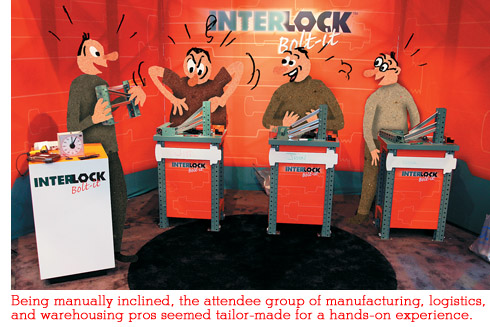
The MG design team started by considering the demographics of NA’s attendee. Being manually inclined, the attendee group of manufacturing, logistics, and warehousing pros seemed tailor-made for a hands-on experience. But nothing too high-tech, Behun says, noting that the 45- to 60-year-old men who largely make up the NA demographic weren’t of the ilk that would respond well to a newfangled video game or whiz-bang computer demo. No, these were the sorts of folks who liked to roll up their sleeves, who relished the whine of power tools, and who savored the weight of cold, hard steel in their hands. On top of that, the MG Design team made note of the competitive spirit it predicted among the groups of two or three company representatives that often attend the NA show together.
With all of these factors at play, what could give Interlake more bang for its trade show buck than a good old-fashioned battle of skill and will?
That battle took the form of the Bolt-It contest — a race against the clock to assemble a section of Interlock rack that would demonstrate the accessibility of the Interlock system as much as its innovation.
|
 |
|
Game On
According to DePaola, “We hoped the contest activity would allow attendees to have some fun while allowing us to demonstrate how easy our product is to put together.” To showcase the contest in style, MG designed the Bolt-It Theater. According to Behun, her crew worked closely with Interlake personnel to engineer the theater out of bolted rack components, creating even greater product exposure for the Interlock brand, and turning the theater space into one giant product display.
Positioned at the center of Interlake’s 40-by-40-foot island exhibit, and free of sightline obstacles for clear viewing from all surrounding aisles, the octagonal theater featured three risers, each faced with a whiteboard for displaying contestant names, a la “Jeopardy” and other TV game shows. The exhibit’s prime location — front and center on the trade show floor — helped draw attendees to the Interlock stage, along with the booth’s bold graphic signage and massive central bolt structure, jutting out from the top of the theater. Once attendees approached the booth, a high-energy actor dubbed Randy “Ratchet” Wright served as emcee and game-show host, selected contestants, and piqued attendee interest with the promise of red-hot tool-on-tool action.
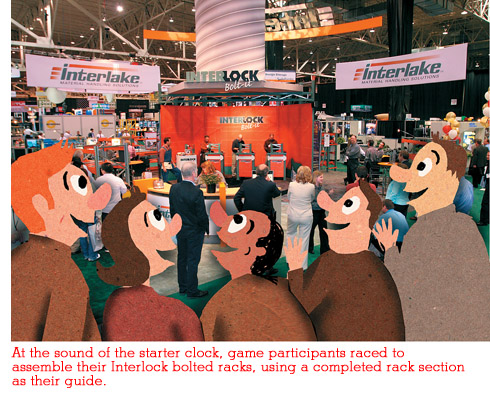
Intrigued competitors took their places at the risers, where each received work gloves and a small powered nut driver, along with rack components. At the sound of the starter clock, game participants raced to assemble their Interlock bolted racks, using a completed rack section as their guide. While they bolted, the emcee rattled off information about the system’s advantages and bantered with onlookers. The first contestant to complete his or her section — assembly times averaged between 60 and 90 seconds — walked away with a handy tool kit valued at $12. But nobody went home empty-handed: Each game’s runners up received a multi-wrench tool as a consolation prize.
During peak attendance hours, a new Bolt-It competition ran every 15 minutes, with many players and non-contestants alike lingering long after play to meet with Interlake staffers. The Bolt-It battle proved so appealing that Interlake saw the number of sales leads jump to 230 — nearly 70 percent more than the company’s goal of 150, a projection based on results from its most recent NA presence.
As a result, Interlake experienced a 1- to 2-percent increase in sales rather than the forecasted decrease in sales volume with the launch of Interlock — a phenomenon it credits in part to the success of the company’s hands-on exhibit at NA 2006.
|
 |
A Re-Bolting Experience
This year’s ProMat show at Chicago’s McCormick Place gave Interlake another opportunity to showcase its Bolt-It game. It also gave the company an opportunity to try out the new tool in its trade show kit: hindsight. Sure, the ProMat booth featured all of the NA exhibit’s bells and whistles — not to mention nuts, bolts, and racks — but Interlake and MG Design further adapted the ProMat exhibit based on its NA experience.
Starting with a pre-show mailing — a component that was left out of the NA show plan — the company focused on building awareness of the Bolt-It game. Since Interlake’s exhibit didn’t have the premium hall position it enjoyed at the Cleveland show, the company added professional gatherers — “Tool Time-type girls,” Behun says — to work the 40,000-plus ProMat crowd. The exhibit was slightly modified to include three flat-screen monitors mounted over the Bolt-It Theater. The monitors featured a count-down clock to each of the in-booth competitions and showcased a promotional video loop between competitions.
Interlake’s ProMat promo proved effective. At the 2006 ProMat show, the company generated 250 sales leads, compared to the whopping 400 leads it collected at the 2007 ProMat show.
Behun attributes the company’s success to the traffic-building Bolt-It contest, the inventive use of Interlake materials for fabrication, and the way the promotion capitalized on contestant competitiveness. “The contest was not expensive, and best of all, it’s scalable,” Behun says. “It’s the kind of thing that can be affordably done by companies of all different budgets and needs.”
Over the course of the NA and ProMat shows, the traffic builder/product demo hybrid brought in hundreds more leads than Interlake expected, proving that sometimes, it’s the nuts and bolts of exhibiting that truly reap the biggest dividends. e
|
|
|
|
 |
|
|


