  t was the road trip to end all road trips. Nearly 7,000 participants joined a Mini Cooper caravan as it traversed more than 4,000 miles through 16 cities in 19 states over a span of 17 days. As far as the eye could see, it was Mini, Mini, Mini, Mini. Minis in front of you. Minis behind you. Miles and miles of Mini Coopers. t was the road trip to end all road trips. Nearly 7,000 participants joined a Mini Cooper caravan as it traversed more than 4,000 miles through 16 cities in 19 states over a span of 17 days. As far as the eye could see, it was Mini, Mini, Mini, Mini. Minis in front of you. Minis behind you. Miles and miles of Mini Coopers.
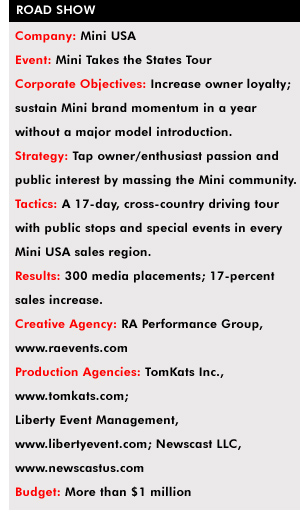
In a year when Mini USA did not have a major model to promote, aside from a limited-edition John Cooper Works Grand Prix (a performance-enhanced version of the 2006 Mini Cooper S), its marketing challenge was to sustain the brand momentum and consumer allegiance from previous years. To do that, Mini USA focused on two of its unique strengths — the brand’s idiosyncratic reputation for playful, nontraditional marketing, and the cult-like devotion that free-spirited Mini owners feel toward their cars. Putting those elements together, the company decided to let the community live the brand by inviting Mini enthusiasts on an epic coast-to-coast road trip — Mini Takes the States — with plenty of free “surprise and delight” activities along the way.
The plan was to start from the Rolex Historic Monterey Automobile Races in Monterey, CA, and motor across America, arriving in Lakeville, CT, in time for the Lime Rock Vintage Car Festival. Mini management would ceremoniously deliver the new John Cooper Works Grand Prix limited edition to lucky buyers at events planned in California and New Jersey.
Along the way, participants could attend events at any or all of the 17 stops, including a Sunrise Beach Party in Monterey, CA; an outdoor film screening in Amarillo, TX’s Palo Duro Canyon; laps at the Indy 500 Brickyard; and even a wedding between two Mini owners, sponsored by Rolling Stone Magazine and Men’s Journal LLC. Mini also made sure participants had ample opportunities to chronicle their journeys, with photo ops ranging from an aerial photo at the St. Louis Arch to a shoot with “Elvis” in Las Vegas.
“Nothing like this had ever been attempted before,” says Trudy Hardy, manager of Mini USA marketing. “We were hoping to have 500 to 1,000 cars sign up. Within six weeks of announcing our Mini Takes the States tour, more than 3,000 cars were registered, and the number kept rising. By offering our customers a one-of-a-kind experience and the opportunity to meet top executives each day of the event, we delivered a brand experience that no other car company has ever offered its vehicle owners.”
And the owners were raring to go. Within the six-week registration period, so many people registered that Mini USA had to shut down the registration Web site because its planned events were maxed out. Ultimately, more than 7,000 Mini enthusiasts participated in at least part of the tour, while more than 150 participants drove the entire cross-country route from California to Connecticut. That’s an unprecedented 17 days of up-close-and-personal consumer marketing to a captive audience.
customers on board
Word of the road trip quickly spread, with the help of viral marketing — drivers searched for Mini information through car clubs, dealerships, and online. Just weeks after the Web site launch of Mini Takes the States, a Google search turned up more than 100 blogs, personal Web sites, online journals, and videos. Many of the personal Web sites were created by Mini owners who wanted to connect with other enthusiasts before the event even started.
The program appealed to a wide range of participants — the cross-country driver, the “weekender” who might drop in for two or three days, and the “day tripper,” who might stop by for a single event. Participants could personalize their daily itineraries and experiences, just as the Mini can be personalized to each buyer’s style.
Although Mini did not charge a fee for the events along the way, participants were responsible for their own hotel accommodations, cars, gas, tolls, and meals, not to mention their precious vacation time. Originally, Mini had planned to foot the bill for all entertainment activities, but as enrollment tripled over initial expectations, it decided to leverage its existing relationships with media partners to create value-added opportunities for the program.
Some activities offset by media partnership dollars included skybox seats for a St. Louis Cardinals game courtesy of ESPN; coffee and pastries for the Mini group aerial photo under the St. Louis Arch sponsored by Dwell LLC; and a charity car wash sponsored by The New Yorker.
The drive was not only a way to foster customer community and loyalty, it also served as a proving ground for the vehicles. Mini deliberately chose a route that incorporated both interstates and secondary highways, giving Mini drivers a chance to test the cars agility on mountainous terrain and seaside roads.
The route ran through the territories of more than 80 percent of the Mini dealerships nationwide, which gave as many dealers as possible a chance to participate and draw customers to the tour. One major activity was staged in each Mini region along the tour.
Mini executives from all regions participated, including Mini’s vice president and general manager, who made the entire coast-to-coast trip, and the top executive from German parent Mini AG, who drove the Monterey to Las Vegas portion. This shared adventure gave Mini management a chance to interact informally with Mini owners and dealers, and brought them closer to their customer base.
|
comfort driving
Mini pulled out all the stops to make sure each participant in the tour drove in style and comfort. The company dispatched two Mobile Assist units that were available during the length of the trip to help drivers with any mechanical issues that occurred on the route. It also planned the tour so that participants did not have to spend more than six hours on the road on any given day.
Mini USA even made sure participants had clean underwear. Automobile and Motortrend magazines sponsored valet laundry bags for all cross-country participants, and Mini also provided “I Crossed the Line!” T-shirts for all the drivers that went the entire distance. In addition, each participant received a small journal in which to record their journey’s milestones.
mini citizens
Mini Takes the States was not just about creating customer community, but about cultivating a socially-responsible community. At each location, events were hosted in conjunction with local charities to create fund-raising opportunities. The Minnie Pearl Foundation, Chet Atkins Music Fund, and a local high school in Arizona were just a few of the recipients of Mini motorists’ generosity.
This charitable strategy supported the Mini USA corporate commitment to philanthropy, the Mini Motoring Hearts charitable program, which matches Mini owners with volunteer opportunities.
mini tour, maximum results
The entire trip was captured on film and video for release on the Web and to other media. More than 13,000 images were posted to the Mini Takes the States Web site throughout the 17 days of the trip. Mini’s public-relations firm, New York-based Rubenstein Communications Inc., placed stories with more than 45 local and national media outlets, and got more than 15 national radio and magazine writers embedded on the road trip.
For what was expected to be a non-news year for Mini, the tour generated a tremendous amount of publicity — more than 300 media placements in local and national print, television, and radio. Equally important, it enhanced the passionate loyalty that Mini owners felt toward the brand and made them instant ambassadors in every town they passed through.
Most significantly, after the tour ended in September, sales in October and November 2006 were up 14 percent and 10 percent, respectively, over pre-tour sales. Year-over-year, October sales rose more than 17 percent. Sales of Mini’s limited edition JCW Grand Prix soared too, becoming the hottest and most talked about launch of a limited-edition automobile in the United States in 2006. This jump in sales was duly noted by the highly respected independent rating service J.D. Power and Associates, which ultimatly raised the Mini brand up 22 spots to No. 1 on its list of "Brand Most Likely to Recommend." e
|


