he traditional approach to marketing is a little like washing your hair: Launch the latest and greatest product with a whiz-bang marketing campaign; monitor and analyze campaign results; adjust future efforts accordingly. Lather. Rinse. Repeat. he traditional approach to marketing is a little like washing your hair: Launch the latest and greatest product with a whiz-bang marketing campaign; monitor and analyze campaign results; adjust future efforts accordingly. Lather. Rinse. Repeat.
To determine the outcome of their efforts, most marketers employ a set of conventional metrics that gauge the appeal of the campaign itself and its impact on brand positioning and brand awareness, such as tracking open and click-through rates, direct-response data, media impressions, and the like.
The problem with this model, according to the results of a research report commissioned by the Chief Marketing Officer (CMO) Council, is that these metrics — the ones most marketers spend their time, energy, and budgets attempting to influence — actually have very little impact on customer purchasing behavior.
Called “Profitability from Customer Affinity: The New Measure of Marketing,” the study, which focused on the enormous, fractured, and competitive information-technology market uncovered what matters to executive- and senior-level buyers, executives, and decision makers.
The results suggest that the continuous
cycle of branding, re-branding, and campaign blasts to which so many marketing departments are held in thrall couldn’t matter less to most customers. Those who participated in the study, in fact, ranked brand perception and promise very low among the factors that influence their decision to choose or to stick with a particular product, service, company, or brand.
So what does influence customer purchasing decisions? Quite a lot of things, naturally, that all add up to what the CMO Council calls “customer affinity.”
The council defines customer affinity as the sum of the factors and forces that shape a customer’s desire, intention, and inclination to do business with a company. It comprises many criteria, including brand awareness, but provides a more holistic and meaningful view of all of the factors that drive customers to make decisions.
These potent factors influence how customers feel about your business, and they include qualities such as: contact frequency, product relevance, customer centricity, speed and effectiveness of response and problem resolution, service and communications caliber and consistency, and cooperative planning and co-innovation.
Measuring these qualities and their effect on the bottom line is the ultimate goal of quantifying customer affinity as a measure of marketing effectiveness. As an event marketer, this should be cause for celebration. What tactic besides a face-to-face event can have a positive impact on virtually every one of these qualities at once?
The Customer Disconnect
Knowing how to make a meaningful impact, however, hinges on understanding what those qualities mean
to your customers — not what they mean to you or your business. And
this is where corporate-customer
relationships are most at risk today.
Your event strategies can help uncover how your customers want to be served, and how they want to interact with you. But to be most effective, you need to understand two things.
First, assuming that the end goal of marketing is to sell products or services, we marketers need to spend less time trying to generate brand “awareness” and more time defining, orchestrating, and activating all of the factors that impact customer purchasing and decision-making. In other words, we need to step outside of the traditional marketing silo and assume a much broader, more strategic role within our organizations by taking into account the full spectrum of organizational activities — such as after-sale service, problem resolution, and co-innovation — that impact customer behavior.
 Second, we need to understand that the surest path to customer affinity begins with understanding our customers. This means knowing more than just demographics and psychographics. You’ll be far more successful if you learn how your customers define qualities such as customer centricity, responsiveness, and co-innovation, and what they expect from their business partners in each area. Second, we need to understand that the surest path to customer affinity begins with understanding our customers. This means knowing more than just demographics and psychographics. You’ll be far more successful if you learn how your customers define qualities such as customer centricity, responsiveness, and co-innovation, and what they expect from their business partners in each area.
Sounds simple, right? But the surprising problem is, most of us are falling down on the job in this regard. Our research points to several alarming disconnects between customers and vendors about these important attributes.
Vendors tend to wildly overrate their level of customer-centricity, with a majority (56 percent) of vendors saying they are “extremely” customer-centric. Customers, for the most part, disagree. More than half say that vendors are only “somewhat” (or “less than somewhat”) customer-centric.
Customers and vendors largely disagree on what the definition of customer-centric is in the first place. Customers say that, above all else, customer centricity begins with the organizational, operational, and cultural alignment of a vendor’s company with its customer. Yet this level of strategic alignment with customers is rarely vendors’ top priority. They typically focus on their own profits first.
When asked how well they are aligned with their customers, only 21 percent of marketers say they are extremely well aligned with customers. But “alignment to my business” was cited by customers as the No. 1 yardstick for measuring an organization’s customer centricity.
Eighty-five percent of vendors say that they are getting better at responding to customer needs. A full 45 percent of customers disagree.
The majority of customers surveyed describe their relationships with vendors as “dependent and captive,” “struggling for common ground,” or “combative and adversarial.”
Clearly, what we have here is a failure to communicate. And clearly, we as marketers need to do a much better job of understanding customers’ real needs.
Event SOS
Your events, where you can interact in a focused, concentrated way with a critical mass of customers, are an ideal place to engage your customers and work with them to define and then demonstrate exactly what customer centricity, responsiveness, and co-innovation mean to your company.
To make the most of the event opportunity, keep these five points in mind:
1. Don’t assume you know what your attendees want. Before you begin planning your next event, conduct a survey. Ask them what’s on their mind. Find out what strategic issues and challenges they are facing. What is it that they need most right now?
2. Get your priorities straight. It is only through better understanding of what drives customer affinity that marketers can improve their budget and resource allocations and influence how their organizations are structured. How do your events help you to achieve that understanding? Do you have a solid strategy for engaging customers in meaningful interactions on site that will help you to accomplish these important research objectives? If not, it’s time to focus less on creating an event “experience” and more on engineering event opportunities intended to gather and extract customer knowledge and insight about their biggest priorities. You can then focus your own post-event marketing, service, and sales efforts on helping them succeed in those key areas.
3. Set specific research goals. Say that your company sees an opportunity to further penetrate a particular market. As an event planner, your first goal should be to work with other stakeholders in your company to determine what you want to learn, specifically, about that market during the event. For example, create roundtables or breakout sessions to get customers talking about the top 10 issues and pain points in that market. How are companies in that market structured? How do their customers look and act? Where do they recognize the greatest profits? Your second goal should be to structure the event in ways that will afford your team ample opportunity to answer these questions. Then have a reporting plan ready so you can share the results across your company after your event.
4. Co-innovate with your customers.
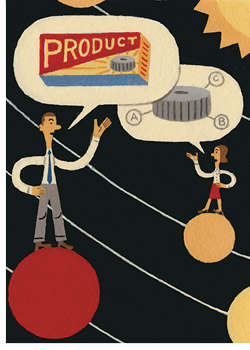 Customers pine for the day when they will be more meaningfully embraced in co-innovation. They want vendors to solicit their opinions on new products and product roadmaps. They also want to know that their feedback is valued and that it influences product outcomes. Yet, according to a 2006 CMO Council study called “Select & Connect: Strategies for Targeted Acquisition and Retention,” nearly three-quarters of marketers do not maintain a customer advisory board or council. Among those that do, only 26 percent appear to take it seriously. Customers pine for the day when they will be more meaningfully embraced in co-innovation. They want vendors to solicit their opinions on new products and product roadmaps. They also want to know that their feedback is valued and that it influences product outcomes. Yet, according to a 2006 CMO Council study called “Select & Connect: Strategies for Targeted Acquisition and Retention,” nearly three-quarters of marketers do not maintain a customer advisory board or council. Among those that do, only 26 percent appear to take it seriously.
Open up internal processes and invite attendees to take part. Instead of only announcing or promoting your latest products and services, why not invite your customers to take a seat at the decision-making table by holding input sessions around new-product road maps? Can you present works in progress to gauge feedback on where you’re headed? Pointedly ask your attendees what product or service would help them better serve their own customers, and brainstorm together how your company can fill that gap. Connect your events to your company’s R&D efforts, and you’ll be well on your way to affinity-building co-innovation.
5. Put your presentations on the chopping block. Stop talking at customers. Instead, engage them directly, with mechanisms for frequent and immediate feedback. Do your attendees arrive at your event, for example, expecting to sit and listen to others, or to fully participate and engage in meaningful dialogue with one another and with you? If more of the former than the latter is taking place at your event, it’s time to adjust your program to include fewer presentations and more discussions. Do you instruct speakers to engage customers workshop-style in an exchange of ideas throughout a session, rather than simply closing a presentation with, “any questions?”
Look to the high-tech industry and its “unevents,” in which attendees design session agendas on site, for more inspiration. How can you scale that idea to your own event? Can you craft a half-day of attendee-led discussion for the final day of your event by inviting their ideas during the first day or two?
In short, it’s time to do whatever it takes to get your customers talking to you about what’s really on their minds — which may be the most powerful change you can make to your event program. In fact, our research suggests that the ability to develop strong interaction with customers — a key component of customer affinity — has enormous impact on vendor returns, and may actually be the most essential determinant of future business performance for vendors in the years ahead. e
|