 |
|
|
|
insight |
 |
|
 s in consumer marketing, Green has become table stakes in the event world: Customers expect you’re running a tight, Green ship. But there isn’t — yet — a clear definition of just what constitutes Green genes in the meetings and events business. So it’s no wonder that event marketers, who are on the hook for delivering the Green goods, are unsure of how to proceed. s in consumer marketing, Green has become table stakes in the event world: Customers expect you’re running a tight, Green ship. But there isn’t — yet — a clear definition of just what constitutes Green genes in the meetings and events business. So it’s no wonder that event marketers, who are on the hook for delivering the Green goods, are unsure of how to proceed.
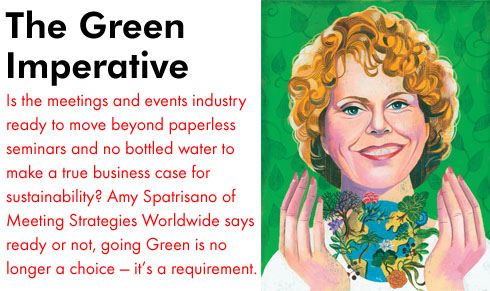
Corporate EVENT spoke with Green events expert Amy Spatrisano about making a business case for Green marketing in the event world, and the trouble with delivering on and measuring this increasingly important requirement.
 Corporate EVENT: How do you define “Green” and “sustainability” in terms of event marketing? Corporate EVENT: How do you define “Green” and “sustainability” in terms of event marketing?
amy spatrisano: Many people use the terms interchangeably. Green usually refers to environments, and sustainability to the bigger, three-legged stool: economic, environmental, and social. But there really isn’t a clearly articulated or consistent distinction between the two in our industry. Meeting Professionals International, for example, defines Green around environmental issues. Outside the events world, it’s usually directed toward social impacts. So now people are using Green to describe everything. This becomes a problem, especially when you’re talking about marketing. What does it mean to your audience? It’s important to be sure you’re talking about the same priorities.
CE: What are some of the biggest misconceptions about Green and what it means to the event industry?
AS: The biggest myth is that it costs more money to run a Green event. Like anything else that you do, there are things that cost a little more, and things that you can save on. But you have to look at making Green choices from an overall budget standpoint — not as a collection of individual costs. For example, on cost alone you likely wouldn’t choose to serve organic foods, which, yes, cost more. But if you save $40,000 because you’re not serving bottled water, you can allocate some of that savings toward more sustainable fare.
Many people think a Green meeting or event is going to be some kind of granola-crunchy, earthy experience, or otherwise “less than.” But think about using china service versus plastic disposables. It’s more environmentally responsible — and it’s also nicer.
If you’re just getting started, we recommend first pursuing these kinds of low-hanging fruit: the things that will mean cost savings or at least be cost neutral, and that will add to or not in any way reduce the quality of the experience.
CE: Of these ideas, which can make the biggest impact?
AS: Financially and environmentally, the greatest impact definitely comes from paper reduction. That’s followed by sourcing locally produced food and materials, and then by a commitment to using and serving organic products.
|
 Like anything else that you do, there are things that cost a little more, and things you can save on. But you have to look at making Green choices from an overall budget standpoint — not as a collection of individual costs. Like anything else that you do, there are things that cost a little more, and things you can save on. But you have to look at making Green choices from an overall budget standpoint — not as a collection of individual costs.
|
CE: For those ready for graduate-level Green, what should they be exploring?
AS: I think it’s really about understanding that Green is strategic. It’s a business practice. If you’re already benchmarking and Greening and showing progress, the next step is looking at social impact.
CE: Explain what looking at the social impact means or entails.
AS: Our industry focuses much more on environmental impact than social impact because, candidly, it’s much easier. It’s far more difficult to benchmark and measure the social impact of Green choices. How do you measure labor practices? Community impact? That’s not just a chart of kilowatt hours that you can track over time.
Supply chain is part of it: Where do your materials come from? How were they produced? When you hold an event in a community, are you doing something that makes the community better because you were there? These are all parts of the social conversation that are beginning to have an impact on event marketers’ plans.
CE: But even some of the simple choices seem complicated. China versus disposables is a perfect example. People sometimes cite this as a no-net-gain choice: Disposables mean trash, reusables mean consuming labor, energy, and water to clean. How does a marketer sort through
all of this conflicting information?
AS: Here’s a stat that came from the Environmental Protection Agency: It takes 10 times more energy and water to produce 1,000 plastic spoons than to wash metal spoons 1,000 times. Having said that, if you use disposables, use biodegradables or compostables.
There is a difference sometimes between biodegradable and compostable. Biodegradable means it could break down in an hour, or in five years. Composting depends on the hotel or municipal system.
That’s another question to ask your venue. Navigating all of this means learning what questions to ask, and a learning curve does exist. That’s the time-consuming part.
Since we still don’t have standards in the United States, it can be difficult to evaluate options and measure the outcomes. So until we have industry-wide standards, your best option is to establish your own goals, and then assess your efforts against your own benchmarks. Meetgreen.com is one resource to help you structure your planning and efforts.
CE: The great irony in this is that events are inherently not Green.
Unless you’re working on a local level, events ask people from around the world to get on planes, stay in hotels, and consume power and resources. How can event marketers respond to this criticism?
AS: There is certainly a lot of conversation around that thought. Should we even get on a plane for a meeting? And this is the first big question. Start by looking at the value of your time, your attendees’ time, and the objectives you need to accomplish. Can you achieve them on a conference call? Via Webcasting? Are there other electronic channels you can use? If not, then it makes sense to meet.
For example, I’m leading a Green meetings standards project with others in the industry. The committee has 15 people spread over nine time zones. It’s taken us two months to develop a first draft. If we had met physically in a room, we could have pounded this out in two days. I’m very sensitive to environmental issues and to people’s time away from the office, so we made the decision to collaborate electronically. But so much is accomplished when you can actually get in a room together.
Will emerging technologies affect this balance? Absolutely. But right now, we’re all so interconnected globally that if we all stopped traveling to meet, then bigger exchanges of goods and services would suffer. Trade is made and broken based on relationships — and those are built through meetings and events. People getting together. People connecting. You don’t reach the same level of comfort on a conference call or with a text message.
CE: At the recent MPI World Education Congress there seemed to be growing chatter that Green objectives would cause companies to reconsider their national events, supplanting them with regional gatherings with specific outcomes. Do you think this is real?
AS: It’s an overstatement to say that these big branding events are going away in favor of smaller workgroup meetings with a defined working outcome. Without getting together at MPI, you wouldn’t have even had a venue to have that conversation.
|
 If any vendor’s Green marketing makes it sound as if it has "arrived" — like they’ve reached the end of a big Green journey — that should be a red flag. This way of doing business is an ongoing evolutionary process. If any vendor’s Green marketing makes it sound as if it has "arrived" — like they’ve reached the end of a big Green journey — that should be a red flag. This way of doing business is an ongoing evolutionary process.
|
CE: I’m noticing a bit of a backlash against all things “Green.” What do you think is driving this?
AS: The biggest challenge is Greenwashing. Hotel chains are some of the worst right now: “We’re supporting rainforests by not changing the sheets every day! Aren’t we Green and great?” But if you dig into their services, you may find no recycling or other basic Green services that today really are expected amenities. If any vendor’s Green marketing makes it sound as if it has “arrived” — like they’ve reached the end of a big Green journey — that should be a red flag. This way of doing business is an ongoing evolutionary process. You can’t just set some Green goals and call it done. If you reach those goals, what’s next?
CE: If we can generalize that people are indeed tired of hearing about it and just want sustainability to be “the way we all do business,” how can event marketers continue to show and prove their Green cred without a sledgehammer approach?
AS: Start talking about it as smart business. Being a steward of humanity, really. A large segment of the meetings and events industry looks at sustainability as something else to do, or the flavor of the month, or a passing trend — instead of looking at it as a way they do everything. Green makes absolute total business sense. The hype will fade. But if you’re not practicing these ideas as core business principles, you’re going to be left behind. I’m already hearing from hotels that are losing business because they have nothing to show for Green. That’s a pretty significant indication that the marketplace will drive it.
CEOs today are making statements that they want their companies to be, for example, carbon-neutral by 2015. Then they look to their event departments and ask, “What are you going to do about that?” Executives are capitalizing on the hype, but they have no idea how they’re going to get it done.
Bottom line, if you’re not looking at how you can cut costs and be Green, you’re going to be in trouble. e
|
|
|
|
|
 |
 |


