loyalty & retention |
 |
 here was absolutely nothing curvy about the chart Mara Weber was reviewing back in 2004. Hardly a bump. Certainly no jumps. This thing was nearly as flat as Kansas. here was absolutely nothing curvy about the chart Mara Weber was reviewing back in 2004. Hardly a bump. Certainly no jumps. This thing was nearly as flat as Kansas.
 Problem is, Weber, then the new director of Honeywell Process Solutions’ Users Group Americas (invitingly known as HUG), was looking at nearly 30 years’ worth of attendance data for the group’s annual user conference. The steady-as-she-goes numbers were a mysterious anomaly for the well-established user group. “We had never broken the attendance record of 600 in any of those years,” she says. “Yet, we had a huge, huge customer installation base, so that lack of growth didn’t make sense.”
Weber turned to feedback from customer boards and prior years’ HUG surveys for clues to what they could do differently. She noticed, for example, that the conference was not promoting its call-for-presentations as broadly as it could, nor was it seeing sufficient representation from Latin and South America, Canada, or other international companies. Problem is, Weber, then the new director of Honeywell Process Solutions’ Users Group Americas (invitingly known as HUG), was looking at nearly 30 years’ worth of attendance data for the group’s annual user conference. The steady-as-she-goes numbers were a mysterious anomaly for the well-established user group. “We had never broken the attendance record of 600 in any of those years,” she says. “Yet, we had a huge, huge customer installation base, so that lack of growth didn’t make sense.”
Weber turned to feedback from customer boards and prior years’ HUG surveys for clues to what they could do differently. She noticed, for example, that the conference was not promoting its call-for-presentations as broadly as it could, nor was it seeing sufficient representation from Latin and South America, Canada, or other international companies.
To address the participation plateau, Weber responded by working closely with HUG’s 12-member customer steering committee to ensure that every element of the conference delivered business value to attendees and that content was driven, primarily, by customer input and needs. Today, for example, the agenda of the five-day event, which caters to those in manufacturing environments who use Honeywell’s high-end technology products and services to streamline plant processes, is chock full of customer-presented case studies and networking opportunities, as well as a technology-roadmap session during which users are invited to provide input regarding Honeywell’s R&D efforts for the coming year.
With the content strategy in line, the HUG team approached the University of Nevada Las Vegas with a joint-program offer. HUG wanted to offer continuing-education units (CEUs) to attendees, which added yet another business benefit to the event since many engineers are required to pursue CEUs to maintain professional accreditation in their fields.
Weber then went a step further by asking questions such as, “Assuming the event has value, what other barriers could be discouraging attendance?” One point in her data analysis had particularly intrigued her: Historical records showed a falloff in numbers — sometimes by sizable amounts — after the first two days. “If you have attendance of 600 and then suddenly, on day two, 50 people leave, that has an impact,” she says.
As she and her team dug deeper in their search for answers, it turned out that the stagnant attendance and mid-week dropoff had very little to do with the conference itself — and a whole lot to do with that elusive concept known as balance.
Becoming Family Friendly
“In examining vacation trends, we saw that people in and outside of our industry were finding it harder and harder to manage workloads and to take the vacation time that they deserve,” Weber says. “We also knew that many of our users already travel extensively, spending a significant amount of time throughout the year away from their families. Some are on the road from six to 12 weeks per year, often on trips that take them out of the country.”
 The timing of the conference itself was another barrier, says Weber, who notes that HUG typically takes place in mid June, the week right before Father’s Day and immediately after the school year ends in many markets. “For many of our users, this is the first week all year that they have time to be together with their whole family,” she explains. The timing of the conference itself was another barrier, says Weber, who notes that HUG typically takes place in mid June, the week right before Father’s Day and immediately after the school year ends in many markets. “For many of our users, this is the first week all year that they have time to be together with their whole family,” she explains.
Conference-goers with young families often feel saddled with even more challenges. “When one spouse comes home from a conference talking about the nice dinners he had and the people he met while the other spouse was home juggling kids, carpooling, work, and other duties on her own, I think it’s enough to make a lot of spouses want to throw their shoes at him,” says business owner Kim Cerny, whose husband, Karel Cerny, works for Georgia Pacific in Atlanta, and has attended the HUG event for the last 24 years.
It was increasingly apparent, Weber reasoned, that the last thing these users wanted to do was to endure yet another run through the petty indignities of air travel, only to spend yet another week away from their homes and families attending a business conference — no matter how valuable the event might be.
For Weber, the solution was becoming obvious. To grow HUG attendance, the event needed to better fit not only attendees’ business needs, but also their lives. “We wanted to find ways to respect our attendees’ family needs and to demonstrate that we know what is important to them,” she says.
Today, it is abundantly clear that Honeywell and the HUG event have taken the respect-for-family-time mission to heart. The HUG event has evolved into a family tradition that everyone eagerly anticipates — and no one wants to miss. “I insist that he goes,” says Donna Wright, whose husband, Robert, is a longtime HUG attendee. “For me, the conference marks the beginning of my summer. It’s my first tan and my first vacation.”
Family Matters
When it comes to HUG, which has a predominantly male audience, spouses such as Wright are not the exception, but the norm. The reason? HUG not only welcomes attendees’ spouses and families to the event, conference staff also bend over backward to develop a full menu of activities — including on-site babysitting service, kids’ events, family-fun nights, off-site excursions such as hot-air-balloon rides, and more — specifically for families.
Honeywell’s incorporation of families into the event is a “welcome anomaly” for conference-goers such as father-of-four Lee Swindler, who is manager of control systems and electrical engineering at Lyondell Chemical Co. in Houston, TX, and whose wife and children, ages 11, 15, 16, and 23, have attended HUG along with him for the last four years. “Before, you had to leave your family for five or six days. When it became an event for the entire family, however, it changed the dynamic completely,” Swindler says. “Now, the entire family plans together, everyone buys plane tickets, and my wife and kids sign up for planned activities in advance. That makes you more committed to the event and less likely to back out of going. It’s on the ‘family calendar,’ and everyone looks forward to it.”
For Swindler, knowing his family is well taken care of and having a great time also results in a higher level of satisfaction with the business side of the event. As he explains, “You gain knowledge and derive a lot of business value from attending the conference, and you get to spend quality time with your family. It’s a win-win situation.”
Since its inception, HUG has always taken place at a posh resort in Arizona, but when Weber’s team became intent on incorporating families into the event, venue selection took on even greater importance. The team began to seek out hotels — such as the JW Desert Ridge Marriott, Pointe Hilton Squaw Peak in Phoenix, and the Arizona Biltmore Resort and Spa, where HUG was held in 2007 — that offered the most in terms of a family-friendly atmosphere, and to give preference to resorts that featured family-friendly activities such as water slides and on-site children’s programs.
Weber’s team also works hard to make the conference as enjoyable for attendees’ spouses as possible by welcoming them on Sunday afternoon in a separate family registration area. There, attendees’ spouses and kids are greeted by registration personnel who hand out lanyards, name badges, and gifts, along with information packets detailing conference activities designed specifically for families. Spouses also receive contact information for their on-site host, Honeywell senior events coordinator Margarita Ceballos, who serves as their main point of contact throughout the event. “It helps spouses to feel more welcomed and taken care of when they have a familiar face to go to when they need help,” Ceballos says. “I tell them to contact me any time for anything they might need, whether it’s helping them to get an impromptu group together for an outing, or coordinating logistics with the hotel concierge.”
The warm welcome continues on Monday morning, when spouses are invited to a get-acquainted event called the Coffee Café, where they meet more Honeywell personnel, mix and mingle with other spouses, and learn about the on- and off-site activities planned for them and their families. A hotel recreation director is also typically on hand to provide an overview of resort amenities and services, such as babysitting services and kids’ programs.
When the Coffee Café ends, the real fun begins with an array of off-site companion activities. In 2007, for example, attendees’ spouses had the chance to take two field trips, including a hot-air-balloon outing and a painting class at a local artist’s studio. In 2006, a group visited architect Frank Lloyd Wright’s home, studio, and architectural campus in northeast Scottsdale, AZ, and attended a wine-tasting event and winemaking class at a local vineyard. Throughout the week, Honeywell also makes regular shuttle service available to spouses who want to spend time browsing for goods at local shopping centers.
“We’re all part of a big family,” says Kim Cerny, a self-described Honeywell cheerleader. “I have met so many nice people at the Honeywell event. A bunch of us women will usually get together and go to Glendale, AZ, antiquing for the day. It’s just a wonderful time. It doesn’t matter that you maybe didn’t know some of the other women before the event. You always find people who want to do something and go out and have fun together — whether it’s shopping, hiking, or having lunch as a group.”
Other adults-only activities that typically take place during the five-day-long HUG conference include a themed Sunday night welcome reception for attendees and their spouses (past themes include “The Crab Shack” and “Jazz in the Park”), and a formal dinner event that takes place on Thursday night.
|
|
IT'S A FAMILY AFFAIR
Here, Mara Weber, director of Honeywell Process Solutions’ Users Group Americas (HUG), offers advice to those considering
a family-friendly strategy for their own events.
 Business comes first. Don’t go so overboard in planning events in exotic locations or overdoing family or spouse activities to such an extent that your conference starts to be seen as a boondoggle. First and foremost, the conference content has to be there, and you have to provide a solid business justification for customers to attend. Then, and only then, start examining attendance barriers to determine whether incorporating family makes sense. Business comes first. Don’t go so overboard in planning events in exotic locations or overdoing family or spouse activities to such an extent that your conference starts to be seen as a boondoggle. First and foremost, the conference content has to be there, and you have to provide a solid business justification for customers to attend. Then, and only then, start examining attendance barriers to determine whether incorporating family makes sense.
Don’t fear Sarbanes-Oxley. Companies fear that offering family activities could be misconstrued as gifts or is prohibited for ethical reasons under Sarbanes-Oxley, so they either avoid incorporating families or do fee-based activities only. Honeywell imposes a separate registration fee for its off-site activities and some family-oriented events to keep its SOx clean.
Allow for split billing. Based on feedback from its customer steering committee, HUG is looking at ways to break its spousal guest and activity fees into separate billing areas so attendees can use a personal credit card for family activities.
Keep attendees focused. If you plan a lot of activities for spouses, it’s a given that some conference attendees will want to go along. HUG reserves these events for companions only. Weber and her team also work hard to ensure business customers remain engaged with the conference by, for example, ensuring attendees have a voice in curriculum development.
|
|
No Child left behind
In addition to entertaining mom and dad, Weber’s team plans plenty of fun for the kids, too. In 2005, for example, children were invited to attend “Southwestern Fun for Kids of All Ages,” where they made animal-themed hats and learned about birds and reptiles indigenous to the Southwest during a live, interactive animal presentation. In 2006, kids in attendance took part in Honeywell’s “Cultivating Wonders for Kids of All Ages” event, where children competed in a “crunch-off contest” that introduced them to fresh vegetables from the hotel garden, and made their own veggie necklaces, flower crowns, bug bungalows, and “Garden Glove Hand Puppets.” A puppet fashion show ended the event. In 2007, both event hotels also offered daily kids’ activities along with the natural kid appeal of just hanging by the pool.
 The fact that Honeywell goes to such lengths to provide activities for kids to enjoy is especially appreciated by moms and dads, says Kim Cerny. “A lot of the spouses don’t get to go on that many trips, and a lot of the HUG attendees don’t get enough time off from work to go on family vacations. It’s so nice for both parents to be able to go on this trip, take the kids with them, and know that there will be lots of things for everyone to do. If these activities weren’t available, I think that a lot of spouses would just stay home.” The fact that Honeywell goes to such lengths to provide activities for kids to enjoy is especially appreciated by moms and dads, says Kim Cerny. “A lot of the spouses don’t get to go on that many trips, and a lot of the HUG attendees don’t get enough time off from work to go on family vacations. It’s so nice for both parents to be able to go on this trip, take the kids with them, and know that there will be lots of things for everyone to do. If these activities weren’t available, I think that a lot of spouses would just stay home.”
Perhaps the most popular activity of the entire HUG conference is Honeywell’s annual “Family Fun Night.” This evening reception is open to all attendees and guests, and is the conference’s one after-hours event to which children are invited and encouraged to attend. Each year, the event theme changes, says Weber. A “Charlie and the Chocolate Factory”-themed event in 2006 featured a “dive-in” theater, stunts, interactive games, carnival-type booths, chocolate fountains, and edible bubbles. “The family events are amazing,” Weber says. “We’ve done themes ranging from ‘Xtreme Sports’ to ‘Pirates of the Caribbean,’ which featured dress-up photo booths, sand-castle building, and treasure-hunt maps. We always try, from the moment that kids walk in, to touch all of their senses.”
For the Charlie and the Chocolate Factory theme, kids entering the event could immediately smell chocolate and see acrobats doing stunts on stage. Oompa Loompas at the front door greeted kids and handed each of them a golden ticket. Weber and her team filled the entire event area with gigantic lollipops and Oompa Loompa statues. “By the end of the event, kids were walking out the door holding giant Styrofoam lollipops that were bigger than them,” Weber says. “Later, we heard from parents that a lot of kids brought their lollipops home with them on the plane and put them up on their bedroom walls, which is something that creates such a positive memory around Honeywell for everyone in the household.”
Big Rewards
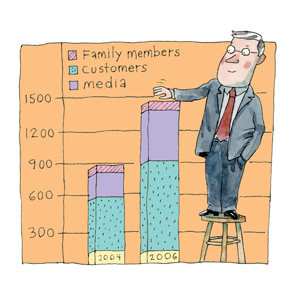
What’s the payoff associated with going to such lengths to include families in Honeywell’s annual user conference? At first, says Weber, it took time for her team’s efforts in this area to yield quantitative results. In 2004, which marked the first year that families were intentionally included in conference proceedings, overall attendance figures hovered around the 600-attendee benchmark, increasing from 567 in 2003 to 604 in 2004.
Positive word of mouth generated by the family activities featured at the 2004 event, however — as well as growing buzz thanks to Weber’s decision in 2005 to actively market family activities in pre-event promotional and conference registration materials — ultimately turned the tide. By 2005, attendance had increased to just over 800, and the following year, it shot up yet again, with 852 customers, 434 Honeywell personnel, and 102 media analysts and business partners in attendance, for a total tally of 1,388. Not surprisingly, attendance trends for users’ spouses and children have followed suit, according to Weber, with 146 companions and 89 children under the age of 18 attending HUG in 2004, and 209 companions and 152 children attending in 2007.
The strategy has also wiped out the attendance dip that Weber had noticed on day three of prior years’ events. “Before incorporating families, we used to see a marked dropoff in attendance with people leaving the event after only a few days or skipping sessions to do other things,” she says. “Now, general sessions on Wednesday and Thursday don’t have the drop-offs we used to see. I think the fact that attendees’ families are there and that attendees know their families are happy and having fun allows them to stay focused on the event itself.”
As with any industry, most attendees have multiple conference options from which to choose each year. HUG’s family -friendly approach, Weber believes, is earning Honeywell a place on more and more attendee short lists. “By creating a family atmosphere, we’re differentiating ourselves from other user conferences,” she says. “We’re creating loyalty with a customer base that comes back year after year, and enticing new people thanks to the buzz these events have generated.” -friendly approach, Weber believes, is earning Honeywell a place on more and more attendee short lists. “By creating a family atmosphere, we’re differentiating ourselves from other user conferences,” she says. “We’re creating loyalty with a customer base that comes back year after year, and enticing new people thanks to the buzz these events have generated.”
QUALITY TIME PAYS OFF
Attendance growth aside, the most noteworthy indications of her team’s success, Weber says, are the enhanced business relationships that have resulted from sharing quality time with Honeywell staff, customers and their families. “When attendees see members of Honeywell’s leadership team there with their own families, and everyone is eating hot dogs together while the kids are laughing, playing, and getting their faces painted, deeper, more meaningful relationships are formed,” she says. “That’s important, especially in our business. When the relationship is there, it not only makes working with customers more enjoyable and more fulfilling for all of us, it also makes it harder for customers to leave Honeywell behind and move to another company. We’re building relationships, but we’re also building loyalty.”
For proof of just how important those relationships are to Honeywell’s business, one need look no further than feedback from attendee spouses such as Donna Wright. “Think about how many companies hold events where attendees go away for four to five days, the spouse stays home, and that’s it,” Wright says. “That’s really the norm. Honeywell is different. This event, I think, illustrates how family oriented the company is and that shows in everything they do. The staff always tries to make everyone feel united, like one big happy family that is working toward the same purpose. It’s especially refreshing in this day and age when people are so often treated like numbers. There’s a real sense of camaraderie at HUG that makes people feel warm and fuzzy. It reflects so well on Honeywell.”
Weber notes that several long-time companion attendees are so enthusiastic about HUG’s inclusion of families that they recently offered to serve as “Spousal Ambassadors” at future conferences, helping Honeywell staff to plan family activities in advance of the event and serving as on-site hosts to other spouses who are new to the conference.
“I’m especially proud of that offer,” Weber says. “To me, their buy-in is just as important as attendees’ buy-in, and their offer to help tells me that they feel a real sense of ownership. That’s how we always wanted it to be.” e
|
SARAH BOEHLE, contributing writer;
[email protected] |
|


