| |
MEDIA EVENT |
 |
Company: Renault España Comercial S.A.
Event: Renault Clio: Feel Your Five Senses
Objective: Gain media attention for a minor upgrade to its Renault Clio model without a big-budget press junket.
Strategy: Stage a press event that focuses on the sensorial experience
of driving the new car.
Tactics: Isolate each of the five senses to illustrate vehicle attributes.
Results: One-hundred percent attendance from the target media list, 100 percent of attendees published an article or news item about the car.
Creative Agency: Global Events ID Corp. S. L., www.global-events.com
Production Agency: Team Tools, www.teamtools.es
Budget: $423,000
|
|
 he new version of the Renault Clio, a mini-hatchback popular with hip young urbanites, looks just like the old version. It has the same interior and exterior design as the old version. It comes in three- and five-door models like the old version. It even comes with the same options, such as parking sensors, automatic headlight washers, and keyless entry, as the old version. The only difference is under the hood. he new version of the Renault Clio, a mini-hatchback popular with hip young urbanites, looks just like the old version. It has the same interior and exterior design as the old version. It comes in three- and five-door models like the old version. It even comes with the same options, such as parking sensors, automatic headlight washers, and keyless entry, as the old version. The only difference is under the hood.
Voted European Car of the Year in 1991 and 2006 by a jury of journalists from automotive publications throughout Europe, the Renault Clio has reveled in popularity, especially among college students, since it was first introduced in 1990.
But in 2006, Madrid-based Renault España Comercial S.A., the Spanish subsidiary of Renault S.A., noticed that the hip up-and-comers who bought the first Clios back in the early 1990s were still loyal to the cars. They were growing up, and so were their income brackets. They still wanted the look, size, and youthful cachet associated with the Clio, but now they also wanted a more powerful engine. The standard Clio came with engines ranging from 70 to 110 horsepower, while the pricier Clio Sport jumped up to 200 horsepower. But Renault kept hearing from car dealers throughout Spain that customers were asking for an engine to fill the horsepower gap.
Renault set out to give its devotees what they wanted, and created a 140 horsepower version. It didn’t, however, want to spend a lot of money introducing the new model to the market. The company had recently doled out big bucks for promotional campaigns to roll out the third-generation Clio, released at the end of 2005. Now it needed an inexpensive way to get the word out about the boost in horsepower.
Renault decided that its best solution was to generate coverage in the industry press. This posed its own challenge: How could Renault convince the press to take enough interest in such a small change to attend a unique and memorable press event, let alone turn a one-line news item — “The Clio now has a more powerful engine” — into a significant product review?
That’s where Global Events ID Corp. S. L. comes in. Renault hired the Madrid-based event-production company to help it create a press event that would attract journalists from Spain’s top automotive magazines and convince them that the new Clio’s story was worth writing. “Renault told us, ‘We have to communicate the fact that we have this new product, but there isn’t much to say,’” says Jorge Hernandez, creative director at Global Events.
Renault identified 90 journalists from the most influential automotive-media outlets in Spain to invite to the launch. Problem was, this jaded audience — 95 percent male, ranging from 35 to 55 years old — was accustomed to lavish product-launch events: luxury venues, gourmet food, fireworks. Each year, this tough audience became even tougher to impress.
With a budget of $423,000, Global Events knew that a high-end pamper fest was out of the question. It had to rely on sheer originality to convince journalists that the new Clio release was newsworthy.
More Than Words
Renault’s challenge to shock and surprise the journalists, even with so little to say, unwittingly contained the answer Global Events was looking for. “We decided, ‘Well let’s not say anything at all,’” Hernandez says. Instead of impressing journalists with technical specifications and cutting-edge design, Renault’s marketing strategy would focus on emotion: the sheer joy of driving the new 140 horsepower Clio.
To pull off a theme as intangible as “joy,” Global Events decided it needed to get all five senses involved, a technique that marketing advisor Martin Lindstrom explores in his book, “Brand Sense: Build Powerful Brands through Touch, Taste, Smell, Sight, and Sound.”
For his book, Lindstrom worked with global market-research agency Millward Brown to discover whether sensory brand experiences help create brand loyalty. The results, based on a series of surveys, interviews, and focus groups in 13 countries, showed that for the 18 global brands tested, positive and negative sensory attributes played a significant role in how consumers perceive the brand.
The research suggests that although most marketing appeals only to sight and sound, taste, touch, and smell are intimately involved in creating a great brand experience and continued loyalty. “It’s very simple,” Lindstrom says. “If you use one sense, you activate one part of your brain. The more senses we use, the more we engage the brain.”
Global Events put this theory to the test, turning the Renault event into a sensorial journey that isolated each of the five senses to encourage the journalists to develop an emotional connection with the Clio. As Lindstrom says, “Our senses are our link to memory and can tap right into emotion.”
To create an intimate environment conducive to developing an emotional response to the brand, Renault decided to split the 90 journalists into three groups of 30, and repeat the event’s activities over three consecutive days. To lure the journalists to the event, the team hosted it in the beautiful countryside near Granada, Spain. Yet to preserve an element of surprise, the invitations did not reveal anything about the sensory experience the journalists would soon encounter.
Although press launches usually begin with a technical presentation followed by a test drive and a gala dinner, Renault decided to do away with the presentation altogether and go straight to the test drive.
On the morning of Nov. 21, 2007, the first group of 30 journalists arrived at a train station in Granada for a behind-the-wheel run through the Sierra Nevada and Las Alpujarras mountain range. After the scenic drive, a bus whisked them to the second, more abstract part of the press event.
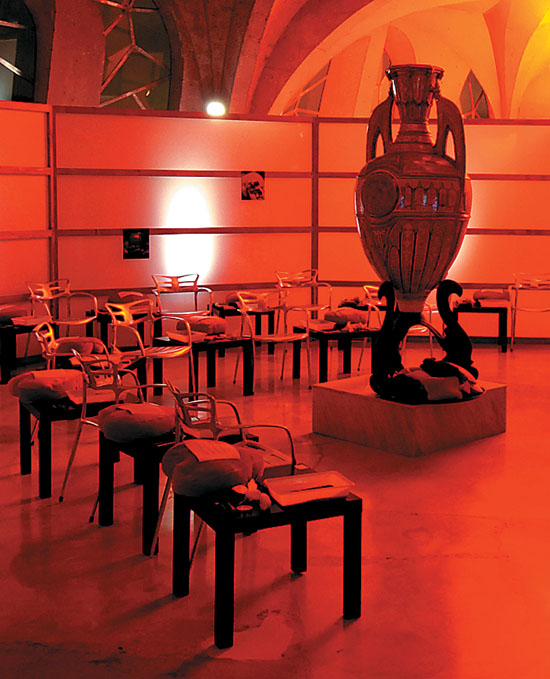
Attendees ended up at the Arts Pavilion, an eccentric sculptor’s avante-garde workshop/museum in a small town near Granada. After they were allowed to feast their eyes on both the venue and their personal hostesses for the evening, professional models, the journalists were blindfolded, and the sensorial journey began.
The Sound and the Fury
The hostesses led the blindfolded journalists to their seats in a room in the museum. Soon the first strains of Stravinsky’s “The Rite of Spring,” an exotically energetic ballet score, signaled that an adventure was about to begin. Over this, a woman’s rich contralto voice explained that the journalists were about to embark on an unforgettable journey — experiencing the Renault Clio 140 horsepower. At that, the anticipatory sound of thunder rolled from one side of the room to the other.
Attendees then heard a Clio door open, and the new 140 horsepower engine start. Accompanied by the Clio’s purr, the narrator asked if they had ever heard such raw engine power, as the sound of the engine gradually turned into the sound of the sea hitting a cliff wall.
Next attendees heard the car window raise, and then nothing but deep breathing, an almost imperceptible heartbeat, and the relaxing sound of a crackling cottage fireplace. It was time to relax inside the car.
The narrator then explained the car’s artistry and the pleasure of driving it through the countryside to the lilt of Mozart’s “Symphony No. 40” and the sound of the wind whistling through a forest. Children’s laughter led into a brief discussion of the vehicle’s security features. Finally, Strauss’ “Also Sprach Zarathustra” (the theme made famous in the movie “2001: A Space Odyssey”) bum, bum, bum, bummed guests to the next part of their blind adventure.
Stop and Smell the Lavender
After escorting the blindfolded guests to the next room, each hostess began talking softly to her charge about a “relaxing journey to the joy of life, to energy.” She then waved a crystal flask, filled with what she referred to as a “child-fresh scent” in front of each journalist’s nose.
The olfactory excursion continued with the models describing places, memories, and emotions, accompanied by a waft of scent. The aromas included a sophisticated cologne (elegance, seduction, and class), lavender (“the places that live in our dreams, landscapes of freedom”), pine needles (travel and adventure), and sea essence air freshener (a romantic sunset by the sea).
The hostesses then brought the journalists’ minds back to the Clio, saying, “All these destinations are yours to conquer. You just have to relax in the Clio and let yourselves go, enjoying what a sweet experience it is to sit comfortably in the car ... (cue a cinnamon scent) ... relaxed but always confident that there is a pureness and strength behind you (Jamaican coffee scent).”
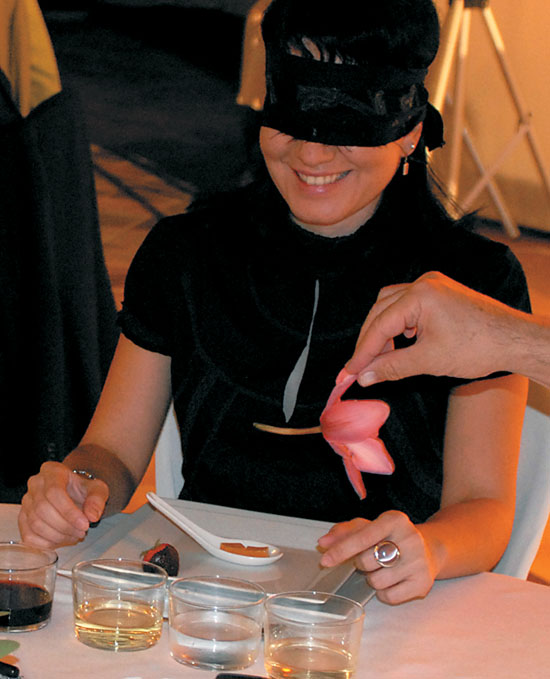
Finally, the hostesses presented journalists with a freshly cut rose, asking them not to forget that some experiences are too delicate and beautiful to be explained.
Reach Out and Touch Something
The touch room used physical metaphors to describe the attributes of the 140 horsepower Clio. The guides first placed three-dimensional, wooden triangles, spheres, and squares in the blindfolded journalists’ hands to orient them to the sense of touch.
Next, as a narrator explained the sensorial significance of each object, the hostesses placed a series of additional objects in the journalists’ hands. Attendees held an ice cube in one hand (the cold logic of numbers and engineering) and a hot water bag (happiness and life) in the other. Beach sand represented fluency and smooth driving, and silk and cotton fabrics symbolized comfort.
The narrator told attendees they could conquer the roughest roads, while the journalists touched sandpaper, and the smoothest highways, while they stroked a velvet cloth. As a final touch, the hostesses placed fresh orchids in the journalists’ hands and had them drop each one on a cushion, to represent the car’s safety features and ability to protect “the most precious thing they have: life.”
Sight to the Blind
At last, the blindfolded attendees were allowed to see. After leading attendees to the sight room, the hostesses removed the blindfolds to reveal a dark theater.
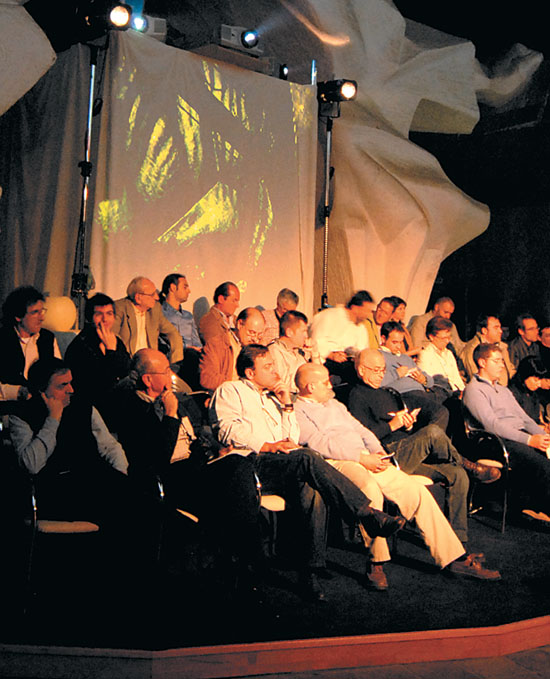
A movie clip started playing on a large, semi-circular, elevated projection screen. The film contained no verbal narrative — just images of powerful natural phenomena such as volcanoes, aurora borealis, electrical storms, and tidal waves juxtaposed with clips of the car racing at full speed. Fast instrumental music tied the images together rhythmically. The film ended with the Renault logo erupting in flames.
In Good Taste
As soon as the movie ended, the lights came up and a Renault executive entered the stage below the screen and said, “Ladies and gentlemen, that was the Renault Clio 140. Any questions?” The now gape-jawed journalists realized that they really had been spared the marketing spiel usually inevitable at such events, and that the sensory experience was allowed to speak for itself.
The executive continued: “Oh, by the way, we’ve forgotten taste, haven’t we? Bon appetit!” More lights cued up behind the stage, revealing table settings for an elegant dinner.
Once the guests found their seats, their personal hostesses blindfolded them again, and an expert gourmet guided them through nine different dishes inspired by Spanish landscapes.
“Let’s first excite our sense of smell with a special, earthy wine from La Janda, with its brisk aroma of Andalusian camps bringing the taste of light, dry almonds to our palate,” said the gastronome. “Discover now the sand, trees, and mountains of Huelva with this mixture of sweet Rota tomato and Jabugo ham … ”
Still expecting a technical presentation or overt marketing presentation, the journalists were pleasantly surprised to end the evening with the leisurely dinner, talking among themselves about the car and the unexpected event.
Sensational Results
After taking such a risky and unprecedented approach to the event, Renault anxiously awaited the results. Would the journalists turn their sensorial Clio experience into positive press for the new 140 horsepower version?
Renault didn’t have to wait long to find out. Within a couple of weeks, the first articles about the new Clio appeared in automotive publications, and soon every single journalist who attended the event published positive reports about the new model.
More importantly, the top four automotive magazines in Spain — SuperAuto, Autopista, AutoCity, and Super Moter — featured complete reviews of the Clio’s engine upgrade, an honor usually reserved for the launch of an entirely new model.
The articles even used emotional, sensory language to describe the vehicles. In SuperAuto, the writer referred to “a new power steering that feels much more effective and sensorial.” Super Motor said the new Clio “will make you enjoy driving,” and talked about experiencing the steering wheel. Autopista claimed the Clio’s “exquisite engine” would make the driver “feel it,” and “fall in love with it.”
Such results were much more than Renault and Global Events expected. “To be honest, the results really surprised us,” Hernandez admits. “We didn’t have high expectations.”
But this year’s Corporate EVENT Awards judges weren’t surprised by the impressive media results. “They were able to take a utilitarian car and turn it into a hedonic experience,” one commented. “How could you not have written about it?” Judges attributed the success to the event’s artful mix of science and emotion. “Their objective was affect transfer — taking something that has a positive, warm image and through an event bringing that positive affect over to the product,” one noted. “It’s been shown to work.”
Lindstrom wasn’t surprised with the results, either. He predicts that sensory marketing is the next frontier of strategic marketing. In his words, “The fact is that we all happen to be installed with five senses — so why not appeal to every one of these if you really intend on seducing the consumer into your world?” e
|