insight |
 |
 ew Coke. Hooters Air. The Apple Lisa. Think for about 30 seconds, and it’s guaranteed that you, too, will come up with a list of spectacular business failures. ew Coke. Hooters Air. The Apple Lisa. Think for about 30 seconds, and it’s guaranteed that you, too, will come up with a list of spectacular business failures.
While few new-product or -business launches end up as New-Coke-style fiascos, it’s true that the odds are against a big launch turning into a big win: Estimates of new-product-failure rates range from 75 to 90 percent.
And corporate events are not immune to failure either. Dozens of
factors — poor timing, a content
misfire, inaccurate budgeting, an ineffective marketing strategy, or weak business objective — can lead to an event concept or program either failing to get off the ground in the first place, or struggling through underwhelming iterations toward an eventual demise.
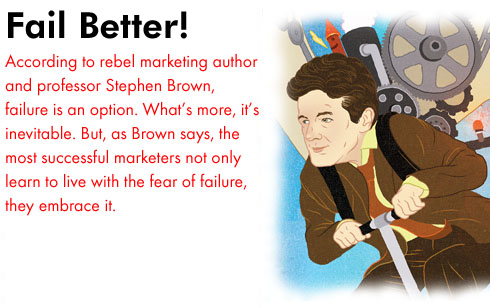
But if failure is so common, why are so many people so shame-faced about it? Corporate EVENT spoke with Stephen Brown, renegade business author and maverick professor of marketing at Northern Ireland’s University of Ulster, about why failure is inevitable — and why that truism is something to embrace.
Corporate Event: Why are people so afraid of failure in business? Why don’t we talk about it more?
STEPHEN BROWN: It’s human nature, I guess. In order to get anywhere in business you have to be optimistic and work on the assumption that you’ll be one of the few who makes it. Indeed, without a can-do attitude you’re highly likely to end up as corporate road-kill. This need for an optimistic outlook doesn’t alter the fact that the odds are stacked in favor of failure. But if you aren’t in, as they say, you can’t win. Las Vegas is predicated on that very principle!
As for talking about it, there’s much more talk about failure than you might expect. Just think of reality TV shows such as “The Apprentice” or “Top Chef,” which are full of “you’re fired.” Likewise, everyone has heard of chick-lit and kid-lit. Guess what: there’s a “fail-lit” genre too! When I was researching for my book, “Fail Better,” I was surprised by the amount of fail-lit that’s available. There are a lot of books about failure, most of which fail to sell — appropriately enough. I like to think that my take on failure is actually very optimistic, because it focuses on those who succeed despite failure after failure.
CE: How do you define failure? Is there some kind of failure that
is more or less “honorable” — or commendable — than others?
SB: That’s an interesting question, and a difficult one to answer because I guess we all work according to personal failure criteria. When Madonna said she aspired to rule the world, anything less than total global domination would surely count as failure. It’s likely she’ll get there eventually. The same is true of, say, Wal-Mart and IBM and GE, which all harbored ambitions to be No. 1, and eventually got there.
Anything that falls short of the targets we set makes us feel like failures. I suppose being regarded as a noble failure or honorable failure counts for something, but not for very much. Winning is everything in Anglo-Saxon culture and, while this win-at-all-costs ethos may be socially dysfunctional, it’s illogical to pretend it’s not there.
CE: In your book, you write that “one thing is for certain: failure.” If failure is inevitable, do you think marketers should simply plan for it? Do you plan to succeed, or do you expect that failure may very well be the case, and have a plan for that, too?
SB: My point is that everything and everyone fails in the end. The final phase of the corporate life cycle cannot be avoided, but with luck, hard work, and humility, it can be deferred for a fairly long time. And while it’s always wise to have a Plan B, or a carefully thought out exit strategy, this inevitably militates against the never-say-die outlook that’s necessary if success is our target. I would say planning for failure has a touch of tempting fate about it. It’s both sensible and foolhardy.
|
 When it comes to events, I feel there is very little room for error. Everything has to be absolutely perfect on the event day — not the day after! — and every single detail has to be absolutely spot on. When it comes to events, I feel there is very little room for error. Everything has to be absolutely perfect on the event day — not the day after! — and every single detail has to be absolutely spot on.
|
CE: Why do you think events fail? Are the causes similar to or different from those of, say, a product failure?
SB: The thing about events, I feel, is that there is very little room for error. Everything has to be absolutely perfect on the event day — not the day after! — and every single detail has to be absolutely spot on. People say that “retail is detail” but events are even more so, I believe. The tiniest little thing can undermine all your hard work and, ironically, it’s the tiny little details that people tend to remember. In my latest marketing novel, “Agents & Dealers,” I describe an event that goes badly awry when the conference delegates’ names are misspelled in the program. For some people, even a typo can be traumatic. So, whereas, say, new-product developers have a little bit of wiggle room thanks to test marketing (such as Hollywood movie test screenings before the big premiere or beta versions of computer software), most event managers don’t have that luxury. The events business is less forgiving than most.
CE: What can face-to-face event planners do to minimize the chance of failure? Or should they simply accept it as a 50/50 proposition?
SB: The best way for event planners to avoid failure is, first, to focus firmly on success and, second, to bear in mind that some of the greatest businesspeople of all time stumbled repeatedly on the road to riches. Clarence Birdseye, Coco Chanel, Walt Disney, Thomas Edison, Henry Ford, Joe Girard, Milton Hershey, and many, many more failed cataclysmically before they finally made it. Failure isn’t fatal.
But it’s important to appreciate that luck is an awfully important part of business life. Being in the right place at the right time is crucial. Clearly, there’s not much one can do about that, but if you work hard and persevere and all those other daily affirmation clichés...you know the rest.
CE: So you’ve beaten the odds and have launched a successful new event. Does the concept of failure-as-fate still apply? In other words, if you have an event that is (or once was) successful, do you keep fighting to the end, or do you recognize — and plan for — a natural arc that ends in an event’s demise?
SB: As I mentioned earlier, it seems perversely paradoxical to “plan” for failure, though there is much to be said for both perversity and paradox. One should never stop looking for ways to keep things fresh and interesting. But assuming that at some point it’s going to peter out, then your well-planned exit strategy is critical to a graceful bow-out. Whether that means simply shutting your event doors or some sort of merger with another event is, ultimately, unimportant. It’s how ready you are to take that bow and move on to the next attempt.
|
 The minute risky ideas are quickly squashed without real consideration, you’ve just lit the fuse that will trigger your implosion. Treat your event as if it’s new each year. Because, really, it is. The minute risky ideas are quickly squashed without real consideration, you’ve just lit the fuse that will trigger your implosion. Treat your event as if it’s new each year. Because, really, it is.
|
CE: How can event marketers extend that natural lifecycle — draw it out as long as possible to fend off the eventuality of failure?
SB: It’s really less about fending off the eventuality of failure than it is about keeping an event — or any product or business model, really — as fresh as humanly possible. Why does Apple issue a new iPod every four hours? Conversely, why is Dell struggling? One is a master innovator — that has had spectacular failures along the way — while the other stuck with one business model for too long, until it was beyond irrelevant. Was Dell just smug enough to sit tight while the world changed around it? Or was it afraid to rock the boat?
CE: That’s a concept you spend a lot of time on in your book — the idea that “success is often accompanied by complacency, conceit, and a cocksure conviction that collapse cannot happen.” What causes this slide into complacency? Is it confidence, or a case of success breeding an even greater fear of failure?
SB: When we succeed, we are inclined to attribute our success to our personal talent, intelligence, innate superiority, etc., rather than sheer good fortune. It’s easy to start believing our own publicity and imagine that our richly deserved success will continue into the foreseeable future because, hey, we’re the smartest guys around. But history shows that organizations are very, very prone to the so-called Icarus Effect, where, as I define it, success gives rise to “complacency, conceit, and a cocksure conviction” that the old rules no longer apply — or apply to everyone else but us. Recent events at Disney, for example, where disgraced former CEO Michael Eisner lost touch with what made Disney “Disney,” are proof that even the highest of high fliers can crash and burn. There any many other names I could name but discretion, as they say, is the better part of a lawsuit.
CE: What are the signs that an event or event marketer has fallen into these failure-inducing attitudes? How do you save yourself — and your event — from “rigid thinking supplanting risk taking?”
SB: The minute risky ideas are quickly squashed without real consideration, you’ve just lit the fuse that will trigger your implosion. The minute you hear — or worse, say — “that’ll never work,” or “that’s not how we do it ‘round here,” you know fear is ruling your event planning. Treat your event as if it’s new each year. Because, really, it is.
CE: Shouldn’t corporate event planners be completely depressed about this whole idea? Launching something, all the while knowing it’s destined eventually to fail?
SB: No, no, absolutely not. Thomas Watson Sr., arguably the greatest businessperson of the twentieth century, failed calamitously on countless occasions before he finally came good with IBM. Colonel Harland Saunders, the marketing genius behind KFC, failed at just about every job imaginable from mule wrangler to ferryboat operator before he hit upon a method of franchising fried chicken. He was 62 at the time. Oprah Winfrey was not only fired from her first job as a newsreader, but unceremoniously informed that she had absolutely no future in television.
Examples of this “Fail Better” propensity are everywhere. We can and should take comfort from the failures of others. If they can succeed after all these slings and arrows of misfortune, bad luck, bad decisions, what have you, we can succeed, too. As serial failure Sir Winston Churchill once put it, “Success is the ability to go from one failure to another with no loss of enthusiasm.”e
|
|
|
|